New ‘Betting on Theo.’ Dev hiding

In this section of what now is called BETTING ON THEO, Theo, the new kid in town, is chased through a neighborhood by the school bully and his friends. Passing an old factory, a gate opens and Theo reunites with Dev, his friend who had been missing for a couple days.  The scene starts in the middle of the chase.

With Bobby Danforth and his buddies more than a block away, Theo leaned against the iron gate. When he heard Bobby Danforth yell, “Wait up,” he waved  and ran a few steps, vaulted a couple tree trunks, jumped through some thickets and emerged back on the main driveway about a fifty feet  from the gate. He stopped just long enough for them to spot him. “Wait up, man.” That was Bobby Danforth. Theo liked the frustration in his voice.  At the cellar, Theo sprinted up the side path and ran till he got to the wooden fence. He made a couple rights and a left and stopped at the corner that would lead back to Main Street and his house, but took the other turn toward County.  Guess I lost them. Ha! He brushed his right hand along the wooden fence, slapping it once in celebration.

Ahead, a section of the fence opened. “In here.”

It was Dev.

“T, what are you doing?” She closed the door and locked it with a thick wooden latch.

“What. Dev?  Wait, over here,” and Theo led her to stand behind a wall. “Bobby Danforth and his guys are following me. Shhh.”

He smiled at her while they waited to hear if Bobby and his boys were still on his trail.  She was tired, her eyes withdrawn and dark.

More than tired, he thought. Beaten down. Lost.

A fist thumped the fence near the gate. The wall shifted with an outside push. “Come on,” Bobby Danforth said. “If you can hear me, Thee awful lee, this  ain’t over.”

Theo and Dev waited in silence. Another thump against a far wall echoed. “Had him running, didn’t we?”

When the street fell silent, Theo asked, “What are you doing here? How long…?”

Dev reached for the bar on the gate.  “You can go, T.” They won’t get you now.”

“No, I just got here. It’s been a few days, you know. Been pretty worried about you. How’d you know it was me?”

“Heard you running. Nobody goes by here,  so when I hear someone, I peek through the wall, just in case.” She stepped back into the main factory building which was missing windows and half its roof. “It’s an old woolen mill.  You’d be surprised how much stuff is still here. This room is warm and isolated.”

Theo glanced around. And dirty and wet and  filled with moldy junk and probably rats…

“Why are…?” Theo held his head with both hands to organize his thoughts. “I know about the farm,” he said and saw her shoulders sag before she turned away. “The grocery manager…”

Dev turned back, face locked, eyes hard. “Did the grocery manager also tell  you he knocked on the school bus every night demanding that I service him? ‘Oh, my beautiful little chicka, I have something for you. I want to make you sing.’”

“Why didn’t you report him?”

“To who? You were there when I said something about Bobby Danforth playing with himself when  I came out of the shower.  They were embarrassed for him, not me.” She touched his face. “You’re a sweet  boy, T. But just go. I can deal with this for a while and one day soon after the farm pays me I’ll  move on.”

He took her hand. “I ain’t going anywhere. I mean I don’t know a lot about all this, but I know what’s it’s like to be alone. What am I trying to say? “I don’t know why you changed your name to Devlin …”

“How do you know I changed it?”

“Jacob told me.”

She pulled back her hand and sat on a dusty  chair. “Jacob. That little busybody.”

Theo pulled up a wooden box for a seat. “That little busybody can help. He’s had his own Bobby Danforth trouble.”

“Why don’t you use of own real name?” she asked. “Theophile, right? Du-boi, not Du-boiz?”

His face crumpled. “I told you. My grandfather…”

“I know. A white Frenchman changed  his name so he could pass for normal.”

“Hey, wait.”

“Stings don’t it?  Try  being the brown-skinned teenage daughter of a Mexican migrant farmworker. What, you thought I had a tan?” She laughed. “I chose Devlin because it was the whitest Irish name I could think of, and no one noticed I don’t have red hair and green eyes, or talk about the ‘old country’ with mist in my eyes.”

Theo stood and pulled Dev from her chair and held both her hands.

“Why you doing this, Dev? I’m your friend. I don’t care that you … whatever. It’s like you trying to drive me away.”

“Ah, T. Don’t you get it? Nobody cares about people like me. What got me in trouble at school? I stole a carton of milk.  They didn’t  ask why I needed to steal the milk and the I only  reason I got caught is that Mrs. Nelson was out that day. I live in a stupid old school bus. It’s like it doesn’t bother them because you can’t really see it from the street and it’s  not in their neighborhood.” She nodded to an opening to another room. “I got a stove and made a bed outta old wool for covers.”

“No, Dev. No.” Theo screwed up his face and close his eyes. “It just hurts to..”

“Don’t do that to yourself, T. Don’t  take it on. You gotta learn to be like the  others. The school doesn’t want to do all that paperwork because in Mrs. Sternman’s mind, I’ll be gone in six months, like all the others.”

“Others?”

“Farm workers, T. Migrants, immigrants, illegals… hiding in the shadows, here for six months till the crops are harvested, then gone. Why bother?” Her voice broke and she covered her face. “I’m  nothing, T. Nothing.”

Theo crossed and hugged her, holding Dev as  her rigid body tried to pull out of the embrace. After a moment, Theo released her and said, “Get your stuff. You’re coming with me.”

“No, what?

“We got a spare room.”

“T??”
“My Mom grew up without a mother.  If she knew I left you here, she’s ground me for the rest of my life and then come and get you herself. So, let’s go.”

Posted in Bergen County Cooperative Library System, Fiction, Hackettstown Public Library, Imzadi Publishing LLC, Michael Stephen Daigle, Paramus Public Library, Parsippany Public Library, Sally Ember, www.michaelstephendaigle.com | Tagged , , , , , , , , , , , , , , , , | Leave a comment

New scene, ‘Betting on Theo:’ Confrontation between school bully and Theo. Wall crawl challenge

In this scene from BETTING ON THEO, the story of three outsiders banding together to challenge the Cherry Street School establishment, Theo and school bully Bobby Danforth face off in a wall-crawl challenge.   If Tom Sawyer and a whitewashed fence come to mind, well, so be it.

The idea of crawling around the wall of Cherry Street School nudged Theo up County Road and into the school’s deserted parking lot. Why’d Jacob make it sound like such a big deal?

He jumped onto the cement base. Clinging with one hand, Theo ran a finger over a couple of the textured bricks and felt the sharp ridges. He thought there must be a lot of kids with little cuts on their fingers. He dropped back to the ground.

Halfway down the right side of the school stood a three-story metal fire escape with platforms on the second and third floors at emergency exits and sets of steps that crisscrossed to the ground.

He wondered if you have to crawl around it, or could you jump back to  the  ground and walk to the other side and then climb back onto the wall.

As he examined the fire escape he reached up to touch hand and foot holds that would make it possible to climb it and never touch the ground. No worse than climbing the walls and hay chutes in Anson’s old barn, he thought. The hay wagons would back up and Theo and half the kids it town it seemed tossed the bales from the wagons to the loft and then on slack days climbed up the piles along ladders nailed to the walls and jumped or slid to the hay covered floor boards, or slipped down the chutes of the feeding bins to a loose pile of hay below.

Theo smiled at the memory of walking home pulling hay out of his hair, shirt and pants.

He turned to the sound of footsteps at the front of the school.

“You’ll never do it,  you know, Thee-awful-lee,” said Bobby Danforth, leaning on the  corner of the school.  “If Mr. Younger catches you, he’ll put you in detention for a month.”

Theo tipped his head to one side and released a scoffing breath. “How many months you been there?”

Bobby Danforth grinned back. “I don’t get caught. But you, a new kid? Country boy, you don’t know how things are done here. There’ll probably be a note on Mr. Younger’s desk on Monday.”

“I’ll make sure I check,” Theo said before starting to walk away around the back of the school, but stopped. “Why are you following me? Or are you here to practice so you can beat your brother on the wall crawl?”

Bobby Danforth stiffened. “You think you know so much. I can do better than he did. I can do better than you.”

“That shouldn’t be too hard. I ain’t ever done it.”
          “Put you’re money where your mouth is. A buck to who stays up the longest.”

Theo stared back at Bobby Danforth’s scowling face and tried not to smile.  “Sure. You go first. I need to see, ya know, how it’s done.”

“Candy from a baby,” Bobby Danforth said. “Start here,” and he walked to the front door where the top of the slanting cement base was about two feet high, reached up with both hands to a row of bricks a foot or so above his head and pulled himself flat to the wall.

That was easier than I thought it would be, Theo mused.

Bobby took a deep breath and slid his feet along the cement and with one hand at a time grabbed a new slot in the bricks.  The wall took an outward ninety-degree  right turn to a new wall, and he easily stepped around the corner and worked along the new twenty-foot wall to another outward corner which this time turned right toward a third wall.

He was breathing harder and coughed out a few breaths of dust. At the next corner, an inward facing ninety-degree turn, he paused and reached to his right across the space to the new wall and tested his balance. He  bounced on his toes and with a grunt, shifted his right side across the opening and for a moment straddled the corner before trying to correct his stance. His feet were too close together and his hands could  not grab a gap between the bricks. He swayed and slipped down the face of the wall, his fingers scraping on the sharp edges of the bricks. He hit the ground and fell backward, his left hand clutching the bleeding fingers of  his right hand. “Damn it.” He winced and reached for his handkerchief to wrap his fingers. “Beat that.” He stood up and limped a few steps. He had cracked his left knee on the cement.

“You okay?” Theo asked.

“No big deal,” Bobby Danforth hissed through clenched teeth. “Your turn.”

Theo stepped to the front of the school, thinking with a tiny smile,  thanks for the lesson. He rubbed his hands together, spit on them, and rubbed them again as he examined the brick face. He reached up with his right hand and found a deep gap in the bricks and pulled himself up. He spread his legs wider than Bobby Danforth had and stood on his toes rather than the soles of his feet. Theo  alternated the height  of his reach as he crossed the wall. At the third turn, the one that had tripped up his opponent, Theo paused. He noticed that the depth of the gaps between bricks on the new wall at his eye level were shallower. That’s what messed up Bobby, he thought. Less to grab.

Theo tip-toed closer to the corner before stepping across the gap. The shift reduced the length of his first step and helped maintain his balance. “Whoa,” he cried and then seemed to slip, before crossing the gap and taking a deep breath.

Theo cling to the wall and seemed to be resting when he heard Bobby Danforth groan and mutter, “Crap.”

Theo slithered along the wall for another ten feet to a set of windows that created a fifteen-foot gap in the bricks. The bottom of the window frames was chest high, but ten feet from the ground with a sloped, wooden sill. Theo reached under the frame and found a space between the top of the bricks and the sill and grinned. Gotcha. He leaned back a little and fumbled along the wall for a few apparent slippery steps and then  pushed off. He landed on his feet, but rolled just for the effect.

“Windows are tough,” he said, brushing off his jeans and shaking his head with determination.  “I’ll have to remember that.”

Bobby Danforth sucked on two fingers to stop the bleeding. He pulled out a dollar bill and handed it to Theo. “Beginner’s luck,” he said. “I pay my debts.”

“Maybe,” Theo said as took the bill and watched Bobby Danforth turn and leave. He wiped the blood on his jeans and smiled.

Good thing I won, I didn’t have a buck.

“Hey, Bobby,” Theo yelled.  “Stop messing with Dev.”

“Whatcha gonna do about it, Thee-awful-lee? First things first. You, then her.” He waited for a reply; when none came he walked off.

Theo smiled and rubbed his hands, feeling the scrapes on the tips of his fingers.  Everyone gets theirs in the end.

Posted in Bergen County Cooperative Library System, Hackettstown Public Library, Imzadi Publishing LLC, Michael Stephen Daigle, Paramus Public Library, Parsippany Public Library, Sally Ember, www.michaelstephendaigle.com | Tagged , , , , , , , , , , , , | Leave a comment

New Cherry Street School. Title: ‘Betting on Theo;’ trouble for Dev: ‘their own kind’

In this segment of the Cherry Street School story, Theo finds something new and concerning about his friend Dev. He hasn’t seen her in a couple of days, not since he saw that she had a bruised eye after a scrap with the school bully Bobby Danforth. Theo has been in his new town about two weeks. At times his loneliness for his old home surfaces, as it does here. At the same time he is gaining some confidence.

The story also has a possible title: Betting on Theo.

Neither Dev nor her father was at the school bus. Theo wandered through the small downtown looking for her, and taking the time to learn more about the village.  He peered into the windows of the café, the hair salon, a barber shop, a hardware store. Cars lined the street as other prowled, seeking parking. Mothers clustered on corners their arms tugged by little kids, who sometimes broke free and with elbows crooked,  swirled around a street sign pole until their mothers stepped from their circle of women, snatched their hands and pulled them away from the street.  A man stepped from the barber shop and removed his cap before running a hand through his newly cut short hair; he replaced the cap and lit a cigarette. At a far corner, along a wall of a vacant lot, a few kids leaned and sat, waving at friends as they drove by.

That was me, Theo thought, suddenly empty again, me and my friends sitting on the wide front steps  of the Lakeside grocery, drinking sodas, grabbing a handful of chips from the giant bag that Jeff had bought and refused to share, laughing at his protest until he passed the bag around, saying, “Hey, not too many.”

Drawn by a blatting, deep whistle, Theo stopped to watch a tugboat and barge enter the lock of the nearby canal. A chipped  blue and gold painted sign said it was the New York State Barge Canal. Theo was fascinated by the process of lowering the water to allow the vessels to continue passage. The growling echo  of the tug engine rose as it sank inside the lock’s walls, the air filled with black exhaust from the stack, which settled about street level at the lowest point. The engine  groaned and the water boiled as the tug and its barge crept out of the lock.

Theo coughed and spit out the black air. Need to learn about this place. Maybe then I’ll know more about Dev.

Finally he went to the Red and White and asked the manager if he had seen Dev, not really expecting an answer, but the man said, “Not in a  week, her old man longer than that. Try Thornton’s truck farm on County Road.”

“Where’s that?”

“About a mile outside of the village,” the man said. “They supply us vegetables and fruit, in season. Plantings started. They’re probably out there with the rest of their kind living in one of the shacks on the farm. The bus is a trade off so the girl can attend school. I’d move it if I could. But  I don’t want the trouble.”

“Trouble?” Theo asked.

The manager glanced around, leaned toward Theo and hissed, “Immigrants.”

Theo felt the sting of the word, but nodded a stiff thanks. Outside as he stared at the purple bus, sadness filled his eyes, then passed as he slapped the tan bricks of the grocery store with his palm, each slap harder than the last. “Jerk,” he said,” then kicked at some weeds growing  out of a crack in the driveway.

County Road ran straight from the center of the village. Theo pounded out his frustration and concern for Dev in every step. Past Cherry Street where the road narrowed to two lanes the houses thinned to open land, stands of trees and fields that surrounded a red barn. An electric fence ran along the road. Cows.

The wind carried in the sounds of machinery and faint shouting. As Theo crested a small rise, he saw a vast farm spread on  both sides of the road, fields, sheds, barns and greenhouses and a billboard announcing, “Thornton’s Farm Seasonal fruit and vegetables” over a faded background of greenish fields, a white barn and little blobs of color  that were probably animals. Along the bottom was a white  arrow outlined in black that said, “Truck entrance ¼ mile.”

Theo had played with his Lakeside friends on their farms and had come to recognize how time and the plantings intertwined.

It was early May. The hay was fresh and green, awaiting first cut. In Lakeside when the Franklins made their first cut the air was sweet and succulent.  The last cut in fall was as dry and scratchy as dust. Before him Theo watched as tractors hauling harrows rolled up the black dirt casting a musk that made the air taste gritty, rich and dark, stinging of manure. The early greens were chopped at the root and tossed in boxes to a flatbed; buzzcut cornfields hid new fresh stalks among the hollow bones of last year’s crop, a fuzz of soybeans, onions, asparagus, cucumbers and eggplants ran for acres squared by rutted paths; the gate to last year’s  corn maze leaned on a bent frame. Later, he knew, warm June, the berries would arrive, fat and ripe, then snap peas and green beans. Somewhere tomatoes, and maybe in the greenhouses to the rear, flowers. By August, hot and parched, squash and sweet corn, round pumpkins, apples roadside in half-bushel baskets; later still, fist-sized jack-o-lanterns, tied bundles of corn stalks  needing witches’ hats. Then chill and darkness,  fields vacant, resting and silent.

It felt good, he thought, to know all that.

At a driveway, Theo saw a “help wanted” sign.

Maybe. I could use the money.

He stepped off the road as a truck with slatted sides  rumbled by and turned into the farm. A dozen workers jumped from the back, and with their broad cloth hats slapped dust from their clothes and stamped their feet to loosen the mud from their boots.  The truck pulled away and the workers in pairs and threes chatting in accented English and another language walked  toward the  row of wooden shacks and trailers that lined the backside of  the inner farm road. Theo stared at a pair of girls in black clothes and ball caps walking arm-in-arm; he heard them laughing, a sound then crushed under the growling engine of a passing tractor.

Theo in his head heard the harsh, spitting voice of the grocery store manager: Immigrants.

Heart sinking; he also he also heard this: Dev.

Posted in Bergen County Cooperative Library System, Fiction, Hackettstown Public Library, Imzadi Publishing LLC, Michael Stephen Daigle, Paramus Public Library, Parsippany Public Library, Sally Ember, www.michaelstephendaigle.com | Tagged , , , , , , , , , , , , , , | Leave a comment

Cherry Street School WIP: Theo meets Jacob, more Dev worries

In this installment of the so-far untitled story about Theo and the Cherry Street School, Theo meets Jacob Sheridan, and the issues about the school bully and the mystery of Dev, deepen. To keep in touch with this story, please “Follow” the website at the link below.

To learn about the Frank Nagler Mysteries, visit the website, and open any of several links.

The story:

Half way across the parking lot, he heard his name.

Hometown Apparel

“Theo, wait.”

He hadn’t heard the boy walk up. Nobody knows me.

“What? Who are…”
The boy extended his hand. He was eight or so inches shorter than Theo, with a round face, round metal rimmed glasses and a crew cut. He wore a red, blue and yellow striped shirt, creased gray pants and black loafers.

Theo shrunk a little, feeling sloppy and underdressed in his faded jeans with the patched right knee, black sneakers and green Farmington State sweatshirt. That was all he had time to unpack.

“I’m Jacob Sheridan,” the boy said. “I’m the seventh grade student president, which make me the official greeter to Cherry Street School.”

Theo shook his hand. “Is that a real thing? Official greeter?”

“Ah,” Jacob said. “Yes and no. It’s something I take on personally, when circumstances call for it. I’m in Miss Wilson’s class. I understand you are in Mrs. Schreck’s classroom.”

Theo wiped his hair. Who is this kid?

“Look, I need to get to her classroom. My papers got messed up.”

“May  walk with you? You’ll have about fifteen minutes before they lock the doors.”

Locking doors, Theo thought. They’re always locking doors. He nodded to Jacob. “Sure, thanks.”

Jacob was smiling. “My, that was some play you made to end the game.”

“Thanks. Try not to think, just react. Bounced it because we didn’t have gloves.” Theo replied. “You don’t play?”

“My mother dissuades it,”

Dissuades it? “Oh, sure.”

“She convinced the principal that my time would best be spent in advanced math and science, not physical education,” Jacob said. “I’m taking calculus and freshman chemistry.”

Theo bit his lip. He had no idea what subjects he was supposed to study. “You some kind of genius? No offense.”

“Oh, none taken. I’m smart,” Jacob said with a short, firm nod. “I was reading at three, playing Brahms at four, and performing piano solos at church at five.” …

Theo pointed to a pair of boys hanging  from the school’s brick wall. One fell, bouncing off his feet and rolling backward.

“What are they doing?” Theo asked Jacob.

“Ah, that’s the wall crawl, a Cherry Street School rite of passage.”
“What‘s that mean?”

“Status is everything at this school,” Jacob said. “Do you need to return home immediately?” Theo shook his head, no. “Excellent. I live a block way.”

The street had cleared of students and vehicles; they walked alone.

“The athletes band together,” Jacob continued, “The pretty girls cling, the less fortune huddle in the corner of the lunchroom.   Clothes matter, your parents’ car, your address, your favorite music, all are subject to judgement. You have to be cool to be included.”

“Wow. All that matters?” Theo asked.

“More than you can imagine,” Jacob said.

The tone of the reply puzzled Theo.  So lonely sounding.

“I take it you’re not cool.”

“I am busy with, well, things, rehearsals and such. I am certainly not an athlete. Besides, my piano concert master would not allow it.” Jacob held out his  soft, perfectly manicured hands.

“Hey, so look, Jacob, I’m new here and don’t  know anybody. And I think you’re cool. But you gotta show me around.”

Jacob’s round face split with a smile. “That, good sir, is a deal.”

“So, what’s the idea with the wall thing?”

Theo caught a look in Jacob’s eyes.

“Interested, are you?” Jacob asked. “It is a challenge and somewhat of a legendary event. It began years ago as just something to do before class. Boys would walk along the wall using the  gaps on the bricks for hand holds. Suddenly it was a competition. If one  boy went twenty feet, another would crawl thirty feet.”

“Anyone make it all the way? In Lakeside the challenge was to swim  to Halfway Rock and back, more than a mile total.”

Jacob offered a winking smile. “One boy, several years ago. John Danforth.”
“Any relation to Bobby Danforth?” Theo asked. “I had a run-in with him at lunch.”

“And he was the boy you threw out at third base to end the game.”

“What are you getting at?”

“Bobby Danforth is, shall I say, the lesser of the Danforth boys. John Danforth is a top student, captain on all the sports teams, the homecoming king…”

“What’s a homecoming king?”

“Did your school not hold ceremonies for graduation, and the like?”

Theo laughed. “Jacob, when we passed one grade to another, we started the next year by sitting on the other side of the room. Anyway, so I take it Bobby Danforth is  not as good at stuff as his older brother.”

“And from what my mother says—she works for the Danforths —  he is reminded of his position often.” Jacob’s eyes hardened. “The Danforths are the most prosperous family in this town.  The library is named for them. Now they own banks. They are respected, but not well liked. From what my mother says, Bobby is falling short of the family model.”

“But he takes advantage of his family’s … whatever it is,” Theo said.

“Yes. How would you know?”

“Knew some kids like that in Lakeside. Families landed on the right side of the money and the kids thought they were owed something for it.”

They paused in front of a brick house with a wide porch.

“This is my house,” Jacob said. “Would you like to come in?”

“Thanks but I need to find someone. Look, I’ll see you tomorrow.” He took a step, then stopped. “There’s something personal between you and Bobby Danforth, right?”

Jacob sighed. “Yes. Last year at the schoolwide recital at the high school,

I was performing a short piano piece when he and two other boys rushed on stage and rolled the piano away. The audience laughed and I was humiliated.”

“And they got away with it.”

“They claimed it was a comic sketch and I was part of it. And that my shocked expression was all an act.”

“And it wasn’t.”

“No.” Jacob stared into the street a moment. “But, it passed.”

Theo shook his head. “Naw,  naw, it ain’t. But I bet it’s hard to stand up to him, huh?”

Jacob shrugged.

“I’ll give you a hand, but I gotta find Dev.” Theo, with a wave, started to walk away.

“You mean Andrea Duarte.”

Theo turned back. “Who? No, Dev. Andrea Devlin.”

“Her name is…look, she should tell you.”

Theo didn’t know what that meant, but it didn’t sound good. “Does that have anything to do with Bobby Danforth calling her ‘onion girl’?”

Jacob frowned. “Sadly, yes.”

Posted in Bergen County Cooperative Library System, Fiction, Hackettstown Public Library, Imzadi Publishing LLC, Paramus Public Library, Parsippany Public Library, Sally Ember, www.michaelstephendaigle.com | Tagged , , , , , , , , , , , , , | Leave a comment

Tea, after

A hand through tousled  hair

Light from eyes once dark

A twisted smile;

A pinch of tea leaves

The aroma drenched with earth and sweetness

You shivered, a tongue touched with honey.

Tea after absence

Tea, after.

Posted in Fiction | Leave a comment

Cherry Street: Theo and the school bully

This is another segment from the Cherry Street School story, yet untitled. In this scene, new student Theo Dubois  has a run-in with the school bully, Bobby Danforth. If you like what you read, please hit the FOLLOW  key on the cover page of the website. Thanks.

The cafeteria in the middle of the school was also the gym. A balcony surrounded the two-story opening. Theo had never seen anything so odd and interesting.

Or loud. The commotion  of a hundred kids talking, scraping chairs and walking, and doors shutting bounced off the wooden walls and hard floor until the air shivered with sound. Some mats hung on the wall did little to deaden the noise, forcing anyone who wanted to be heard to speak louder than the person next to them.

Theo spotted Dev sitting alone and joined her.

“Hey,” he said.

She didn’t look up.

“You should move on, T. You don’t want to be seen with me.”

“What’s that mean? You’re the only kid who talked to me. I mean I was in Miss Denison’s class and we were doing math and since no other kid answered the questions I ended up answering them all, and they laughed.”

She looked up. Her right eye was bruised. He reached to touch it and she pushed his hand away. It was then he noticed how green her eyes were.

“What happened?”

“T, look. There’s them and there’s me.  The good kids and the girl who lives in a purple bus in a grocery store parking lot. The kid who wears black because she can’t afford anything  else and who any day now could become a ward of the state, or worse. If you get messed into this, they come after you too.”

She crushed a packet of saltines.

Don’t care, he thought.

“You want a sandwich?” Theo asked. “I got two.  Where do you get milk?”

“”T… no.”

He reached for her hand. “Dev, yes.” He wrinkled his nose.

She  held his hand and bit her lower lip while she stared into his eyes. “At the end, next to the cashier.”

“Got it.” Theo pulled two sandwiches wrapped in waxed paper out of the bag and passed one to Dev. “Be right back.”

He took two cartons of milk and an apple for Dev. The cashier said, “Forty cents, please,” and Theo passed her one of his dollar bills and said thank you as he took the change.

As he turned, a kid about his size bumped into him and  the change fell to the floor.

“Hey look, Onion Girl’s new friend, ” the kid said to the two boys with him. “The new kid, Thee awful lee, can’t handle his  milk.”

Theo looked at the floor to spot the coins, “Sorry…” How does he know my full name? I’ve never talked to that kid.

“Son, leave it there,” said the cashier, a thin black woman with a blue vest over her red blouse. “Bobby Danforth you pick up that boy’s change. You did that on purpose.”

Kids in line at the service line stepped back.

Son of gun. Bobby Danforth.

“Not gonna,” Bobby Danforth replied.

She stood eye-to-eye with the kid.  “You start picking up that change right now,” she said in a loud, shrill voice that pierced the buzz of the room. “Or I’ll have you reported to the office before you get to your next class. Besides, I’ll see your mother tonight at the church board meeting. And with the number of incidents you’ve caused in this room, I can guarantee that you won’t be playing on the baseball team because my son is the coach.”

The cafeteria din softened; students turned in their seats or stood to watch the confrontation. A murmured “ooh” floated in the air. Flashes of cell phone cameras lighted the room. Theo glanced around and back at the cashier. Everyone was watching him. I don’t want to be in the middle of this.  Dev was standing, her face calm and dark, a look that Theo could not read. 

The glare that the moment  before  filled Bobby Danforth’s eyes melted to indecision. “Don’t tell her.” A near whimper. “Please?” He blinked and elbowed one of the other kids in the stomach, “Help me.”

“You  better find sixty cents, or it’ll come out of  your pocket,” the cashier said.

Bobby Danforth and his two friends bent to search for the dropped change.

“Got it,” Bobby Danforth said, standing and handing Theo two quarters and a dime.

“How nice of you,” Theo said. At the side door Bobby Danforth turned back to Theo and offered a hard, warning smile; one by one, he and the other boys ran out. The show over, the students turned back to their own business and filled again the room with chatter.

“Thanks,” Theo said to the cashier, “ I…”

“You’re new,” she said.

“Second day. I’m Theo Dubois.”

“I’m Mary Nelson,”  the cashier said. “Mrs. Nelson.” She smiled. “You watch yourself, Theo Dubois. That Danforth boy thinks he runs the world. Now you go take care of that poor girl. I can’t watch all you.”

He returned to the table and delivered a carton of  milk and the apple to Dev.

“That’s how you got the black eye, ain’t it?” he asked.

When she didn’t reply, he reached to her chin to lift her face; when she resisted, he pulled his hand away.

He leaned his head in. “One thing you’ll know about me, Dev. I don’t scare off.”

He took her hand when the bell rang and folded into it the other dollar bill and the change. “I’ll get more,” he said and stepped away.

Posted in Bergen County Cooperative Library System, Fiction, Hackettstown Public Library, Imzadi Publishing LLC, Michael Stephen Daigle, Paramus Public Library, Parsippany Public Library, Sally Ember, www.michaelstephendaigle.com | Tagged , , , , , , , , , , , , | 2 Comments

Cherry Street School: Theo’s first day ends, shops at the Red & White

Since I seem to be serializing this story, in this segment, Theo Dubois ends his first day at Cherry Street School feeling lost and alone.

Theo rolled the paper grocery bag under his arm and turned left at the end of the school sidewalk where it met Cherry Street. He looked back at the school and felt dizzy. The day had been a blur of unfamiliar voices and pointed directions –boy’s room is down there,  cafeteria downstairs, all with a  wrist wave and why-don’t-you-know scowl — and heads turned then turn away as kids entered the office and Theo was still sitting on the bench, and all of Mrs. Sternman’s twitch smiles and frowns had not found him a classroom.

His stomach grumbled with hunger and an uneasiness of not belonging. More than once he wondered of anyone would notice if had just left.

Then the last bell and the hallway behind him rumbled with kids banging and slamming toward the doors. When one of the secretaries walked out of the office with her coat and handbag, Theo stepped out behind her because no one stopped him.

 Alone on the sidewalk, he closed his eyes to recall in reverse the path he walked that morning.

Cherry Street  crossed County  Road, a wide, four-lane street. Then it was three blocks up to a no-name street with a green house with a white fence where he turned right. But that street jogged left at a tall wooden fence that had a locked metal gate, so he walked along that fence for a block, turning right  to follow the fence for  another half-block to an intersection where Theo went straight and the fence turned right. He paused and glanced back at the street he had followed  and down the fence to its end, for a moment confused. All those turns the fence took hadn’t sunk in that morning when he ran past on his way to school, but now, walking, it seemed odd. He leaned his eye up to a crack in the fence and saw a red building.

I wonder how to get in?

Crap, the kids.

He started to run. His younger brother and sister Paul and Annie were probably home already. And the boxes are still in the middle of the room and there’s no food. They probably got a handful of papers like Mrs. Sternman gave me.

It was easier in Laketown.  All the kids jumping out the school door getting yelled at by the teacher to watch for trucks that couldn’t  stop in time rolling down the steep hill past the Franklin farm; thirty kids peeling off to their houses yelling and waving like a joy bomb going off. And if was a Tuesday or a Thursday, Theo would run into the side door of the coffee shop, pour a Coke, throw  on an apron and go to work.

He wasn’t supposed to use the grill or any of the hot stuff, but Teddy, the high school kid, would let him flip burgers now and again.

Theo had learned how to serve coffee without spilling it, to make milk shakes on the blender and not make a mess, and slap a scoop of egg or tuna salad on bread, flatten it out, add tomatoes and maybe lettuce and cut it diagonally without losing a finger. Mostly he served chocolate milk and Cokes and donuts to his friends, even though he would tell them the donuts were probably stale, but they didn’t care and laughed and joked and dunked them in their chocolate milk, except for Jeff, who dunked them in his Coke.

The memory made him feel heavy; he shuffled the last three  blocks home.

Annie and Paul were asleep, curled up on the mattress  in the middle room. On the table were two piles of papers, one in a wad, Paul’s, and  Annie’s neatly stacked.

Theo wasn’t surprised they fell asleep. They all had been running for three straight days after their father said without warning, pack up, you’re  moving to New York. He remembered that a couple friends stopped by on their bikes and asked what was going on. “Don’t know,” Theo said. “Guess we’re leaving.”

 He wondered if the kids dozed off at school like he had at one point sitting on the bench; a slam of the door to his left woke him before Mrs. Sternman noticed. She would have frowned.

The trip from Maine took twelve hours. Their father loaded all their furniture and stuff in the rental van and drove off. Theo, the kids and their Mom made the trip later in her little sedan. Theo tried to sleep in the passenger’s seat, head resting on a pillow propped against the bouncing window glass. The kids stretched out on the narrow rear seat, waking and grabbing when they rolled onto a pile of suitcases wedged between the seats.

Theo through one open eye watched his mother as she drove, face  crumbling in hurt, hands clenched on the steering wheel in anger, sometimes singing wordless tunes, but always smoking, her window open a crack to let out the smoke and allow her to toss out the finished cigarette after lighting a new one with its glowing butt. Sometimes she seemed calm, but then her face would tighten and the car would lurch forward at higher speed for a few miles. One time he reached over to touch her arm and ask if she needed to rest. She shook her head and stared at him with wild eyes as if she didn’t recognize him and had just returned from someplace else.  “I’m okay, Honey,” she said.  “We’re almost there.”

Theo had heard the shouting, the stomping, seen the dishes flying across the room to shatter at his father’s feet; had seen her rage and pain explode as he stood treelike unmoved. The first time, Theo thought, he was just calm; later Theo realized he just didn’t care.

No, Theo thought, as he pulled the pillow into a ball, we left “there.” We’re nowhere.

****

His father had left an envelope with ten $20 bills. Theo took two and wrote a note:  “Gone to store. Don’t leave house.”

The house  was at the corner of a busy wide street, and a street without sidewalks. It was gray and three stories tall. It had a big side yard and a barn at the end. The kids will like the yard, Theo thought.

A post on the front porch had a number: 311.

A metal street post had two signs. One running in the same direction as the big street said, “Main.”  The other  one was broken and said only: “Ow.”

There was a doctor’s office across the big street. A good landmark, he thought, like the busted up oak on the side of the hill  above halfway rock that let you know you had taken the right trail off Bear Hill. He had missed that sign one time and ended up at the far end of the lake out near Butternut Swamp at nightfall. He spent some time splashing around the edges of the swamp until he saw the light at Bachelor’s store.  There had been another fight. His father was gone whwen he got back and his mother was in her room with the door closed and didn’t respond to his knock. At least the kids were asleep.

He slipped to the lakeshore and sat hunched, arms around knees, head sunk, squinting across the dark water wondering if they even knew he had been gone.

****

He didn’t really know what to get at the Red & White. Milk, that made sense, and bread and peanut butter and grape jam. Some hotdogs, and ketchup. A couple boxes of cereal. Cookies. He wondered how he was going to carry it all  home, about eight blocks.

He added canned spaghetti, the little letter kind that Paul liked, and raviolis.

The woman at the cash register smiled and handed him the change. It had cost about $35.

Theo rolled the tops of the bags and grabbed the lighter one by the top and encircled the other heavier one in his arms. He juggled the  bag to get one hand under the heavier bag.  At the automatic door the heavier bag broke open and the cans rolled toward the sidewalk.

Only then did Theo collapse  against the wall and weep.

Posted in Bergen County Cooperative Library System, Fiction, Hackettstown Public Library, http://www.sallyember.com, Imzadi Publishing LLC, Michael Stephen Daigle, Paramus Public Library, Parsippany Public Library, www.michaelstephendaigle.com | Tagged , , , , , , , , , , , , , , | Leave a comment

The things we hide: WIP

Years ago I started sketching out a story about a weekly Maine  newspaper editor named Hadley Chandler. It was planned as an episodic story with threads that involve an old family farm, industrial pollution, the ups and downs of the old town.

I was looking for that story that I either have in on paper in a file somewhere or the electronic version got lost in a past computer failure.

When I’m planning a story I often write scenes, rather than take notes. That way I can begin to experiment with characters and settings.

This is one such new scene, and it adds to the mix Elizabeth Margaret Denard, a wealthy woman who is suing Hadley Chandler, and her dead aunt Senator Margaret Denard, who had  deep secret her niece wants to know.

“Mr. Chandler?”

The woman’s voice echoed from the office to the press room in the rear of the building.

“Out here,” Hadley yelled. He set aside the pair of wrenches he had been using to tighten a bolt on the press and wiped his hands on a succession of red cloths until the ink was a mere stain on his palms.

He turned to the slim woman in a chic, unadorned black dress and wide white hat silhouetted in the dim hallway lighting.

“Hello, Miss Denard. Audrey Hepburn?”

Elizabeth Denard laughed, deliberately showy.

“Was thinking Sophia Loren, but I don’t have the chest for it.”

Hadley smiled as he escorted her into his cluttered office. That was the Betsey Denard he had known.  Somerset High School’s leading actor, statewide renown, front pages in all the state’s newspapers, even a mention in the  Boston Globe when Somerset’s cast won a New England award for a wrenching production of “Othello,” in which she played Iago.

Hadley had written dozens of stories about her career, from her transition from a fresh-faced sassy, Betsey Denard, to a hard-edged  Liz Denard when she conquered Portland’s banking community, to whatever she fancied herself now as Elizabeth Margaret Denard.

And now she was trying to put him out of business.

He wondered if it was because he once wrote that her middle name was not Margaret, and suggested she had claimed that name to add heft to her declarations of importance.

Because her aunt, Senator Margaret Denard,  was a heavyweight who fought for the rights of women, Native Americans, battled the paper companies over river pollution and developers over the need to preserve the state’s farms. Hadley knew the senator had gone head-to-head with Will Hathaway’s grandfather more than once.

Hadley Chandler was one of maybe six people in Somerset who was allowed  call the late senator Maggie and not be greeted with a scowl.

“So, Betsey,” Hadley said as he cleared  a chair, “What brings you to Somerset? You haven’t shut me down yet.”

Her soft, round face hardened at the sound of her discarded name, but she did  not correct him.

“Have you not cleaned this office since I was last here?” she asked.

Hadley sat and pushed aside the pile of stories he needed to edit, and  waved at the messy space. “It’s a museum in here.” He leaned over the desk and hardened his voice. “And if you win your lawsuit, this could be yours.”

A thin, inscrutable smile. “I don’t want to win, Hadley. Because I do  not want this newspaper. There is no profit in this business, and further, I do  not want to be known as one of those hedge fund managers who buys properties to drain them financially and close them. Certainly  not in my hometown.”

“So why did you sue? You want that two grand back that much?  I did pay her back taxes. It cleared up the title to the  building. The receipt is in the court documents.”

Elizabeth Denard removed her white hat and the dark, round Hollywood sunglasses before reaching into her black handbag and producing a few letters in colored envelopes which she placed on the desk.

She indicated the envelopes with a nod. “I believe you know who this person is.  As you know I am my aunt’s sole heir, at least I thought I was until a search of her estate house by my attorney found these letters.” She leaned back. “You  should be honored, Hadley. You are the second-most mentioned person in my aunt’s detailed and immaculate records. Why is that? We’re you sleeping with her?”

Hadley was intrigued as she turned her face to the window and the firm, thin mouth and jutting jaw melted into a wrinkled-browed, lip-biting softness.  Hadley wondered how much of that look was acting, and how much was fear.

“You don’t know, do you?” he asked.

“What does that mean?”

“You don’t know what to ask. You suspect your aunt had a deep secret, and you would be right. And I know it.”
          She jumped to her feet,  scooped up the letters, her bag and her hat and began to leave. “You can tell that secret in court.”

“No, Betsey, you don’t want me to tell that secret in court. It’s not in the paperwork, ” he said calmly. “Will Hathaway knows what I know. It’s what we have been trying not to say in court. In a way I think you’ve known it all along.”

Her head jerked to one side and her eyes narrowed in confusion.  Her hands shook as she dropped her belongings on the desk.

That, Hadley decided, was not acting. She had been acting her entire life, that scared, uncertain kid she was as a child buried beneath the roles she had chosen to control herself and others.

“Sit down, Betsey. I’ll tell you what you need to know.”

****

The office door ground open.

“Dad? Dad? Is it true?”

“In here,” Hadley replied.

It was his 19-year-old daughter, Sarah, the freckled faced, long curly haired spitting image of her mother, down to the old hippie clothes she had borrowed.

“She dropped the lawsuit? Really? I mean I just ran into Will, er, Mr. Hathaway, and…”

“Yes. She did.” Hadley rose and embraced her. “This old mess is still mine. And it could be yours. Betsey agreed to invest in the company as a silent partner so we can upgrade all our systems.”

“Wow.  No lawsuit and new computers,” Sarah said, sitting. “What did  you have over her? Finances? Secret lovers?”

Hadley motioned for Sarah to close the inner office door.
          She did and then sat with a grin and one eye closed. “Ooh, secrets.”

“The kind which you can never tell. Life changing stuff. Got it? It’s not ours to tell.”

Sarah nodded, “Got it.”

“Do you remember a woman named Susan Smith? She worked on campaigns  and other election stuff?”

“Right. She came to the school and talked about voting rights. Very intense.”

“She was Maggie Denard’s lover, for decades.”

“Really?”

“You have to understand, this started maybe fifty years ago. Maggie was in her twenties. A woman state senator did not….”

“No, Dad, I get it. She, the senator, or either of them, could  not tell anyone. So how’d you know?”

“Maggie and I had been friends for years. I covered her campaigns as a reporter for the Sentinel. Over the years, we had quite a few drinks at the Senator Hotel in  Augusta during legislative sessions. One night Susan came in and it was obvious why she was there.”

“And you, the great reporter, didn’t tell anyone. The scoop of a career and you kept to yourself.”

Hadley shrugged. “Private stuff. Didn’t matter.”

“Anyone else know?”

“Maggie’s staff, I’m sure, but they were loyal.”

Sarah took her father’s hand.  “How hard it all was. The secrets, hidden lives.” Eyes wide and jaw dropping. “And you, all this time? How?”

“I gave her my word. Before we shared politics, we shared friendship.”

“How did they cover for it, which is a terrible to have to do, all that hiding.”

“Susan was a party official so it was natural that she and Maggie appeared everywhere together and didn’t raise suspicion.” He kissed her daughter’s hand. “But  she carried it with her. You look at photos of the time and while Maggie is smiling, her eyes are dark and sorrowing. Look at what issues she championed. The rights of the dispossessed. That’s how she expressed her anger and distrust of the  system.”

Sarah waved a hand in the air.

“So how did Maggie have Betsey’s mother? Adopted?”

Hadley smiled. “Maggie took a couple years off. Her seat was that secure. But the story circulating at the time said she was  recovering from stress or fatigue – something a woman legislator could suffer  without harming her political career because, after all, they were the weaker sex.” He winked.

“So who…? Wait, that’s why Betsey called Maggie her aunt, not her grandmother. They kept it from her. You’re  not Betsey’s grandfather by any chance?”
          Hadley laughed at his amazing daughter. “No. Please. The last great secret.”

Sarah screwed up her face. “How did Betsey take all this?”

“She was relieved and troubled. She knew there were secrets but had no place to start looking. Thus the lawsuit. She thought my records would have the information, that, you know, the two grand loan was a payoff… and no it wasn’t, there, kid. But after I told her all this, she never asked the question I thought she would: About her legitimacy and the succession of the family fortune.  She’s the only one left. Instead she said she was attracted to the role of Iago because of his suspicious and scheming nature. So she schemed and plotted and up to this point it has left her angry, suspicious and alone.”

“Wake up call?”

“We’ll see. She’s planning  to reopen her aunt’s estate house as a women’s study institute.”

“That’ll be cool. So, there, Dad, why Betsey no husband and kids?”

          “That, my modern daughter, is the question for another day. By the way, I told Betsey her real middle name is Susan.”

Posted in Bergen County Cooperative Library System, Fiction, Greater Lehigh Valley Writer's Group, Hackettstown Public Library, http://www.sallyember.com, Imzadi Publishing LLC, Michael Stephen Daigle, Paramus Public Library, Parsippany Public Library, www.michaelstephendaigle.com | Tagged , , , , , , , , , , , , | Leave a comment

Thanks for these top reviews

Thanks to readers of the Frank Nagler Mystery series for these top reviews. Forever grateful.

THE SWAMPS OF JERSEY.  Why are an old swamp, a burning factory and a dead woman linked? Why is Ironton, N.J. detective Frank Nagler so concerned that Lauren Fox left town? Paperback, ebook, Audiobook.

5.0 out of 5 stars Frank Nagler is a Sam Spade for our time!

As I began this book, I could almost hear Humphrey Bogart reading the narrative portions describing the fictional town of Ironton. Frank Nagler is a tough, gritty, and tired detective who has yet another murder to deal with, and a local government that’s reeking with corruption. Throw in a sensitive side and a “foxy” woman, and Nagler’s cynical humor is often laced with memories of happier times. The story is occasionally long with descriptive passages, but the action is fast paced at other times and keeps the reader committed to finding out who the girl in the bog is and who killed her. I look forward to future Nagler tales!

A GAME CALLED DEAD. Frank Nagler must track down an Internet terrorist whose past intertwines with his own. Paperback and ebook and audiobook. A Runner-Up in the Shelf Unbound 2016 Best Indie Book contest.

5.0 out of 5 stars Nicely done

Good writing, strong characters, and a plot that works. Starts off with a gasp-inducing crime scene that almost made me stop reading the book. But, like Nagler, I persevered. And I am glad I did. Good descriptive writing and character development. The story works because you come to care about these characters. Nicely done. I will be reading more.

THE WEIGHT OF LIVING: The discovery of  young girl wearing summer clothes on a bitter March night leads Frank Nagler  into a search through a dark history that has surprising connections to his group of friends. Paperback and ebook.

First Place for Mysteries  in the 2017 Royal Dragonfly Book Award contest;  Notable 100 Book, Shelf Unbound 2018 Indie Book Awards; Named a Distinguished Favorite, 2018  Independent Press Awards; Distinguished Favorite in the 2018 Big NYC Book Contest; Finalist in the 2019 Book Excellence Awards.

Named A Gold Star Award winner in the 2020 Elite Choice Book Awards

5.0 out of 5 stars Intense, dark, fascinating!

Early on, I assumed this would be a typical crime thriller – crime, clues, solved! Boy was I wrong! This book was filled with suspenseful subplots. I couldn’t put it down! I didn’t realize this book was a part of a series until I was partially through and am thrilled to say that it makes a great standalone book. I can’t wait to read the rest of the series!

THE RED HAND: Frank Nagler’s beginning, a struggle in a terrorized city with a serial killer and a personal battle as his wife fights for her life. Paperback, ebook audiobook. Distinguished Favorite in the 2019 Big NYC Book Contest; Second Place winner for mysteries in the 2019 Royal Dragonfly Book Awards;  Notable 100 Book in the 2019 Shelf Unbound Indie Book Awards;  Distinguished Favorite  in the 2020 Independent Press Awards; Nominee in the 2020 TopShelf Book Awards

5.0 out of 5 stars Enjoyed it

Reviewed in the United States on January 15, 2022

The Red Hand is a thrilling and dark read. I enjoyed the MC– Frank. He’s a well-developed character I quickly became invested in his arc. The pacing for this book is pretty good, I had a hard time putting it down– reading late into the night!

Posted in Bergen County Cooperative Library System, Fiction, Hackettstown Public Library, Imzadi Publishing LLC, Michael Stephen Daigle, Paramus Public Library, Parsippany Public Library, Sally Ember, www.michaelstephendaigle.com | Tagged , , , , , , , , , , | Leave a comment

Who are the real heroes in the Frank Nagler Mysteries?

Growing up in Upstate New York I was under the influence of Syracuse University.

That meant my sports heroes included football stars Ernie Davis and Jimmy Brown.

Both were All-Americans at Syracuse and Brown later starred for the Cleveland Browns. Davis, sadly, died young of leukemia.

In addition, because my mother  was from Boston, another group of sports heroes were the Boston Celtics, mainly Bill Russell, Sam Jones, Satch Sanders, and K.C. Jone

Bill Russell with Red Auerbach; Ernie Davis; JIm Brown

As a kid I was also riveted by news film of the civil rights and voting rights  movements taking place in the South at the time.

Later as a reporter with the Daily Record of Morristown , N.J, for one Martin Luther King holiday story I interviewed a white minister from Dover who was a student at Little Rock High School when the school was desegregated, a Morristown bar owner who with his wife were teachers in Mississippi during the voting registration drives, and members of Morristown activist community who fought housing discrimination.

This came to mind over the weekend when I read a story from Indiana about a GOP lawmaker who filed a bill requiring that state teachers provide a “balanced look” at  such topics as slavery, Naziism, authoritarianism and the like so Indiana students would not judge such movements harshly.

Had two thought.

First, if the legislator can not talk to a relative who fought in WW2, he could at least Google Sen. Bob Dole, visit the library for a picture book on the war or watch any of the histories on TV that show the rise of Hitler, Stalin, Mussolini and any of the  gallery of dictators which plagued the world.

Second, he is another example of the GOP effort to recruit the dimmest bulbs in the hallway to run for office.

That report also made me think about my imaginary town , Ironton, N.J. base for the Frank Nagler Mystery series and the choice to include as many diverse characters possible and give them important roles.

This is not an effort to be “woke,” as is the current term.

These characters go back to the first drafts of the mysteries  written in my 20s.

Great stories have memorable minor characters who served to move the story and expand the universe.

One such character is Manny Calabrese, an Italian jeweler, who appears in several books. During an interview about THE RED HAND, the host noted how Manny reminded him  of  shopkeepers in his hometown, people who knew their customers, patted kids on the head. It was one of the highest compliments I had received.

Manny, like Barry, the Hispanic owner of Barry’s, the popular Ironton eatery, exists to add sympathy for Frank Nagler and the main characters, and add depth to the life of the city without caricature.

Leonard, for example, appears in the earliest drafts as blind street kid.

Over the stories he becomes owner of a bookstore which becomes a cornerstone for redevelopment of a section of Ironton.

There’s Del Williams, Detective Frank Nagler’s  black childhood friend from the worker’s ghetto. Nagler is always recounting their escapades. Del overcomes addiction  to become a leader and trainer for the street kids hired by Leonard at his store and other businesses.

Calista Knox overcomes child abuse and sex trafficking to become a hero in THE WEIGHT OF LIVING, and Nagler’s companion, Lauren Fox, represents all the qualities of the many women administrators, social workers, nurses, cops, fire fighters and others I have had the privilege  to know as a reporter. Nagler doesn’t succeed without her.

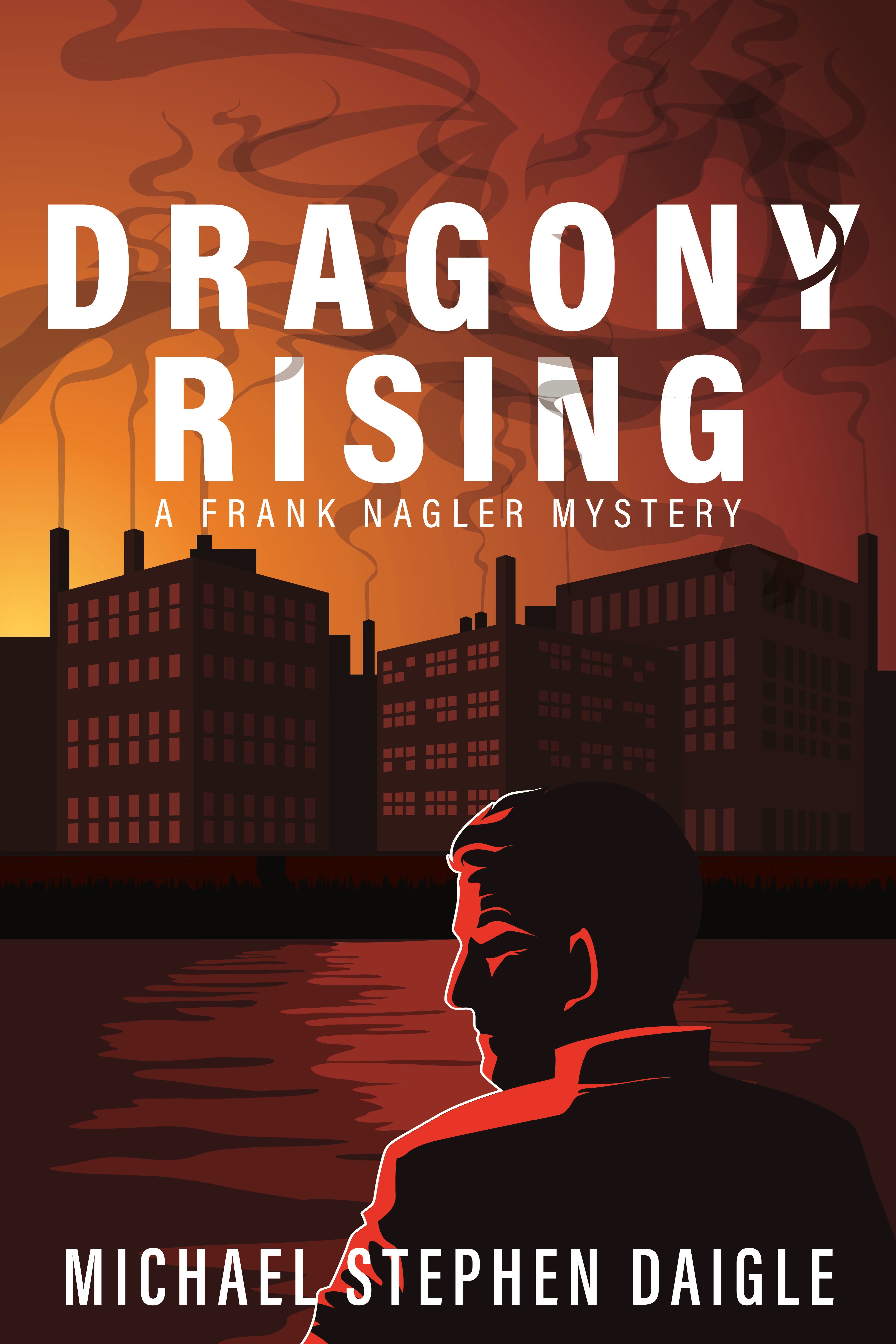
One of the favorite heroes in the stories is Lt. Maria Ramirez, Nagler’s no-nonsense partner. In the upcoming DRAGONY RISING, Ramirez and her companion, Destiny, are endangered because of their sexuality.

These characters exist because they make the Nagler stories more interesting and lively, not to make it appear that I am a writer trying to be  heroic or politically correct.

I am instead a writer partaking in the world that is, the one I learned about by living.

That brings up one more point.

A week or so ago I started a story about an elementary school I attended.   It was supposed to be a goofy growing up story.

Instead, “Dev” showed up.

She is the daughter of a farm worker who disguises her upbringing.

Where did Dev come from?

As a kid in Phoenix, N.Y. I would ride my bike past vast fields of vegetables – truck farms.

At the far rear of the fields were shacks and tents when the migrant workers lived.

That’s where Dev came from.

Where to find the Nagler books:

Amazon.com: Michael Stephen Daigle: Books, Biography, Blog, Audiobooks, Kindle

The Weight of Living by Michael Stephen Daigle, Paperback | Barnes & Noble® (barnesandnoble.com)

Posted in Bergen County Cooperative Library System, Greater Lehigh Valley Writer's Group, Hackettstown Public Library, Imzadi Publishing LLC, Michael Stephen Daigle, Paramus Public Library, Parsippany Public Library, Sally Ember, www.michaelstephendaigle.com | Tagged , , , , , , , , , , , , | 2 Comments