Irving Bernstein as a character resulted from a conversation that began with a talk about a black fedora. It ran onto a talk about bad suits sold at a famous discount store.
And then he showed up in my work in progress, NAGLER’S SECRET, as a source about the early life of my cop hero, Frank Nagler.
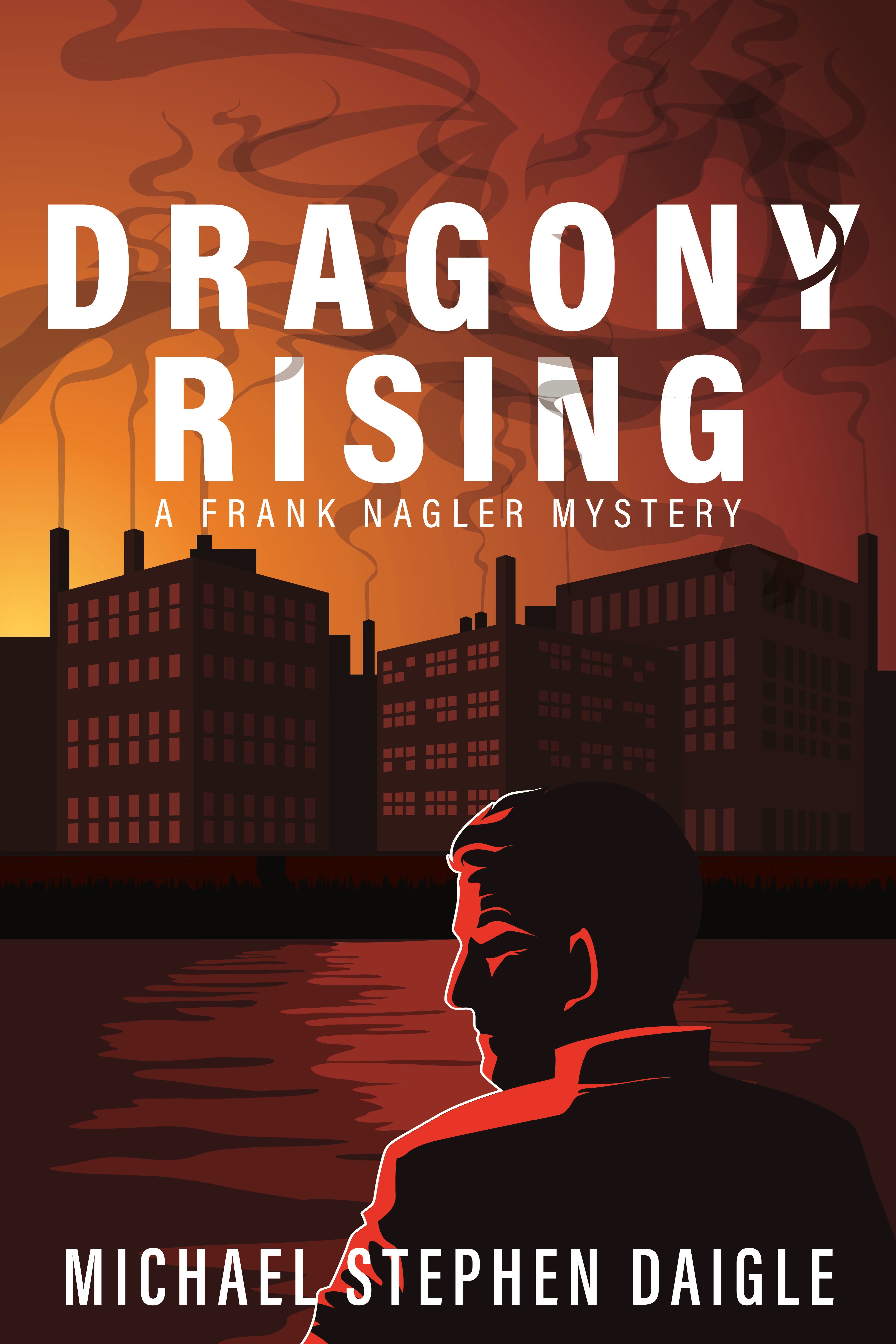
Nagler’s Secret is book six in the award-winning Frank Nagler Mystery series about the life and times of Ironton, N.J. Detective Frank Nagler
Find them here:
Amazon.com: Michael Stephen Daigle: Books, Biography, Blog, Audiobooks, Kindle
The scene:
“Irving Bernstein was one of those guys.
He was everywhere.
And you knew it was him, even if you didn’t see his face because he was wearing one of his gawdawful red yellow green blue checked plaid striped sports jackets that looked like it was sewn from the stuff left on the cutting room floor after the good suits were made.
Frank Nagler would spot him on the street or at the edge of a crowd at a crime scene, start to ask him a question, and then dazzled by the sheer audacity of a garment so awful, would shake his head and say, “Irv.”
The other thing about Irv is that he knew everything.
Nagler could never figure out how Irv knew all that he knew.
He just knew it.
It wasn’t that Irv was a criminal, although he appeared to have no means of support, and he wasn’t a snoop, a pimp or a loan shark.
Irving Bernstein just was.
****
Irv sat alone smoking a comically fat cigar, his eyes like a ferret’s, buried inside his fat face pushed up from his collar-buttoned shirt like it might burst. The gamblers hunched in the dark over beers and weak whiskey at computers underneath screens flashing games of all sorts or announcers moving their mouths but making no sounds.
It was all remarkably refined, Nagler thought, soul killing, cold and about as much fun as a tax audit, but refined, bloodless.
Nagler had dropped into the old horse betting shops when he was a kid. Smoke and curse filled parlors of dead hopes, factory guys trying to turn a two-dollar bet into grocery money.
****
Irv waved his cigar.
“Thought you couldn’t smoke in here,” Nagler said as he sat on a chair opposite Irv.
Irv grinned and expelled gray smoke through his teeth.
“Who’s gonna stop me?” He sucked on the cigar again. “World’s too polite, Franky. Look at this place. Betting on stupid stuff. Is the next pitch gonna be a ball? Will the player make that free throw? They lose, there’s no consequence because they put it on their Amex. Back in the day, Franky.” He waved the cigar. “Back in the day.”
“Back in the day, Irv, the wrong bet got you killed.” Nagler leaned back to get out of firing range of the cigar. “How old are you, Irv? You seemed to be a hundred years old when I was a kid.”
“Ah, you was never a kid, well, you was never young. Couldn’t be, coming out of that ghetto. Always looking for something, and you found it with your wife. She was something. I knew her parents, did business with her father. Oh boy, did he dislike you at first, poor ghetto kid, factory kid. But that Martha. Aces, Franky, aces.”
Nagler winced. “She tracked me down, filled me up.”
“Then, she …”
“Yeah, hardest thing, hardest thing ever. What was I like after that, after she died? I try to look back, but it’s a hole.”
“You was hollow. Somedays I was waiting for you to crack like a fancy flower vase, pieces all over the street. Know guys who did.” Irv waved the cigar again. “But you didn’t, and now look at ya, you’re a big shot.”
“Naw, Irv. I’m just a cop, and I got a question.” He pulled out the Polaroid that showed him and the woman with the porcelain face and black hair. “Know her? Or someone who might?”
“She ain’t involved with the white suits and the dead kids, Frank. She’s got another gig. Not any better, but not that one.”
“Why don’t I remember her?”
Irv shrugged; the ash tip dropped off the cigar onto the table. “Cause you don’t wanna.”
Nagler slapped the table, scattering the ashes. “I have to. We found this picture on the wall of an eastside drug house.” He narrowed his eyes. “Come on, Irv. You know something.”
“Sweet nothings, Frank. Pink pens, little hearts. Infatuations. You were running, running after things, running from things, but when you think about that time, there was a moment when you slowed down, maybe got distracted.”
“What?”
“Got your old yearbook, Frank?”
“What the hell does that mean?”
“Means what it says.” Irv leaned in, gray ash hiding the burning cigar tip. “You always wonder what I do, dontcha? I get people unstuck. Did that for Martha’s old man, and he was really stuck. You, not so much. You’re just stubborn, afraid of being wrong. We’re all wrong sometimes, Franky. You were moving so fast, you never faced it.” He leaned back and sucked on the cigar and exhaled a billow of smoke that ran up his face. “Go talk to Kate, the old nun.”
“Sister Katherine.” Nagler chuckled. Christ.
“Me and her go way back.”



Stand with the theater kids as they stand up to censors
UPDATE: In recent days this post has attracted over 70 visits, surprising for a post written in May. During this spree, I received a message from Robin Lisherness, the director of the play and beloved Skowhegan teacher. He made two points. First, the weight of the production of a controversial play was greatly stressful but generated great pride among the students. Second, he said that in talks from time to time with students who took part in the production, they still discuss the importance and impact of the play.
This was an event that mattered. As a newspaper editor at the time, I felt it was important to cover the story of the play and the challenge to it. What the Skowhegan kids did then is worth remembering. You fight for freedoms by practicing them. The same is said about the item that leads this post, about the Indiana kids who took the same stand.
Congratulations to both.
Cheers to some Fort Wayne, Indiana high school thespians who defied religious censors and the local school board, which banned the play, by performing it on their own outside the school.
The play featured roles of interchangeable sexuality and clearly expressed the world view of these kids which features tolerance, diversity and equality.
They found community support and even some professional help to stage the play.
And the world did not stop spinning.
Not news, but never ending.
In the mid-1980s I was working at the Waterville, Maine Sentinel when in the nearby town of Skowhegan this scenario of an outraged minority Christian community trying to censor a play was performed.
But unlike the Fort Wayne school board, the Skowhegan Board of Education approved the performance after a marathon board meeting that attracted nearly 600 visitors.
It was a dramatic night of community and a fun night of newspapering in the pre-Internet, pre-cell phone, pre-computer days of the business.
Skowhegan is a mill town that has been a business and community center for about three centuries. It is perched at the modern intersection of U.S. Routes 201 and 2 along the Kennebec River.
Benedict Arnold had to drag his heavy bateau over the tall Skowhegan falls on his way north to Quebec City, Canada where he was defeated in an epic Revolutionary War battle.
It was also the home of U.S. Sen. Margaret Chase Smith whose 1950 Declaration of Conscious pulled the first piece out of the Zenga tower of lies and conspiracies built by Sen. Joe McCarthy.
The play in question was called “When the Lord Come to Sand Mountain” by Romulus Linney. It was a companion to another short play about the lives and tall tales told by Appalachian Mountain folks.
In the play Jesus and Saint Peter are travelling the mountains on sort of a fact-finding mission.
Jesus engages a man in a contest of tall tales, each one stretching the truth evermore.
The last tale Jesus tells is about a carpenter named Joseph and is a parable that sounds suspiciously like the Golden Rule: Treat others as you wish to be treated.
The “why” of the play was to show Jesus seeking the story of his father and how that story offered The Lord the strength and knowledge to continue his mission of salvation.
The fundamentalists objected to the play because it was not exactly Biblical and contained many innuendoes and double-entendres that suggested that there was a lot of “be-getting” going on in those hills, in other words, folks being folks.
So the climax of the debate took place at the school theater and offered about 80 people the chance to speak for 3 minutes.
Yeah, they started early.
The newspaper side of this begins here.
Our reporter Marie Howard was on the scene at the high school. Our only communication devise was a pay phone in the lobby.
The Sentinel at the time published four local editions.
The first went to northwest towns and the second went to Skowhegan.
We were prepared to send the first edition out with a story that said the vote as still being taken.
But we had to have the vote for the Skowhegan edition.
As was the practice, we wrote the story from the bottom, with background in a file and Marie’s live from the scene reporting added about every 20 minutes.
We had to have the decision by 11:15 p.m. to make deadline for the second edition.
About 10:50 p.m. she calls.
This is it, we thought.
No. They were taking a break for 5 or 6 minutes.
The conversation went something like this:
Marie: They’re taking a break.
Me: They can’t. Don’t they know we’re on deadline? Get back in there and tell Betsy (the school board president) to get that meeting started again.
Marie: Laughing.
In the end, the board unanimously approved the performance. Betsy told the church folks that they had made a valid point, but that their right to hold that opinion was no greater than the right of the students to perform the play, and the right of the school district to support free speech.
She basically said, if ya don’t like the play, don’t go watch it.
This tale ends with the Skowhegan kids performing the play at a statewide theater competition.
That was not unusual. Skowhegan had a reputation for challenging, innovative
productions that won many awards.
What was interesting about that night was the pre-performance conversation at dinner. The air in the restaurant buzzed with talk of the Skowhegan play and the fight to perform it.
Share this:
Like this: